
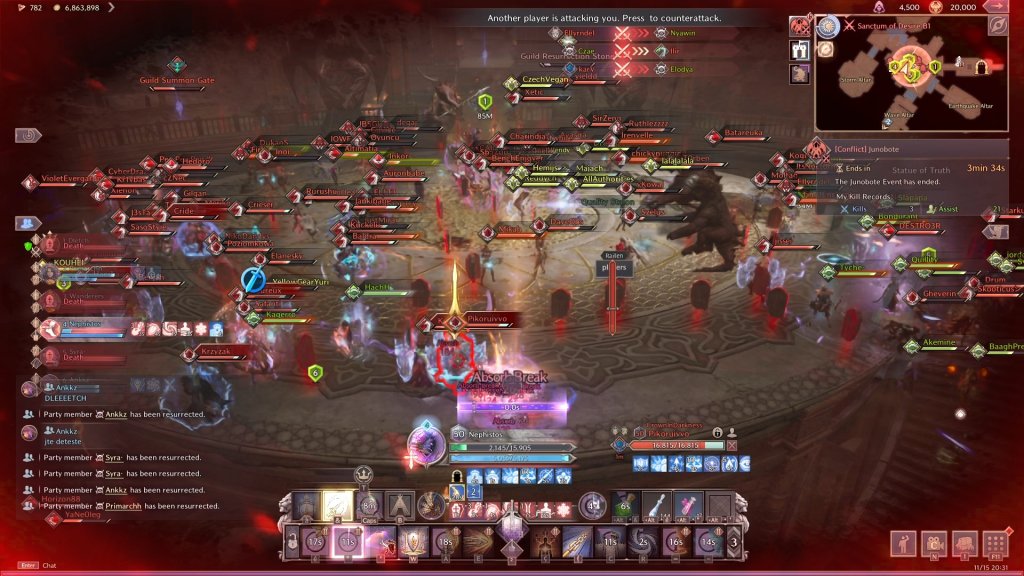
Throne and Liberty recently had a siege battle with 3,900 players at once, which suggests that technological boundaries are being shifted. However, this feat also begs the question – as developers push the boundaries of combat’s scale, are we compromising the essence of what makes combat appealing?
Making such a big player-versus-player battle is probably a dream for many MMO developers. We used to see games like Albion Online, with a few hundred concurrent players in PvP battles, as a significant milestone. Surprisingly, Throne and Liberty has far surpassed this competition. However, the increase in player count seems to be more than just a technical achievement and might signal a potential paradigm shift in how we picture massive confrontations.
The compromise
From where I stand, the combat system shows how hard it is to manage such a large player count. Throne and Liberty basically uses a standard tab-target combat with minimal action-oriented elements. That’s not a bad thing in itself, many players enjoy this kind of gameplay. However, relative to the industry standard, it does not hold up. The way it has been implemented feels dated, especially when compared to established titles which also share a tab-target gameplay.
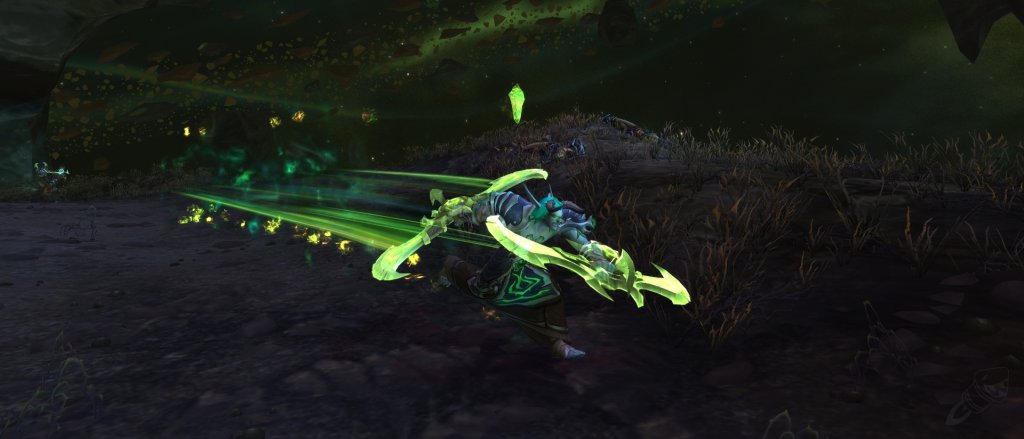
Among other things, most abilities either prevent movement or have long cast time, there are not many areas of effect or cleave (which is pretty bad in the specific context of large-scale PvP), the ranges of melee attacks is super short (to the point that it’s difficult to engage an opponent who simply walks away), most skills require a target, plus cooldowns are much longer than you would like to. If you add it all up, you realize that the number of interactions between two opponents in a typical Throne and Liberty fight is probably considerably lower than for competitors with the same type of gameplay.
But to add insult to injury, the way the game’s targeting works is super unintuitive. To be fair, it can actually be hard to pick an enemy accurately. The way you tab-target from one target to another feels random, with the game trying to compensate this by proposing a laborious “target priority” system. My impression is that these mechanical parameters illustrate how efforts to sustain these mega large scale battles are sabotaging a potentially better gameplay.
Server meshing
So, how do we keep gameplay fun to play when thousands of players are concurrently engaged in a same event? Cutting-edge tech like server meshing (currently under development for projects such as Star Citizen) could be the breakthrough. This technology could help bigger battles to happen, while still allowing for more elaborate gameplay choices.
Rather than limiting the whole game world to one server’s computing power, server meshing split the world into cells managed by a different server. This method shares computing power fairly and gets rid of single server performance blockage. How inter-server communication works in a server mesh is its sophistication and what make it different from sharding or layering (that we can respectively see in WoW and WoW Classic/Season of Discovery). Servers regularly swap and synchronize entity states, so players experience the same persistent world whatever on which physical server they are.
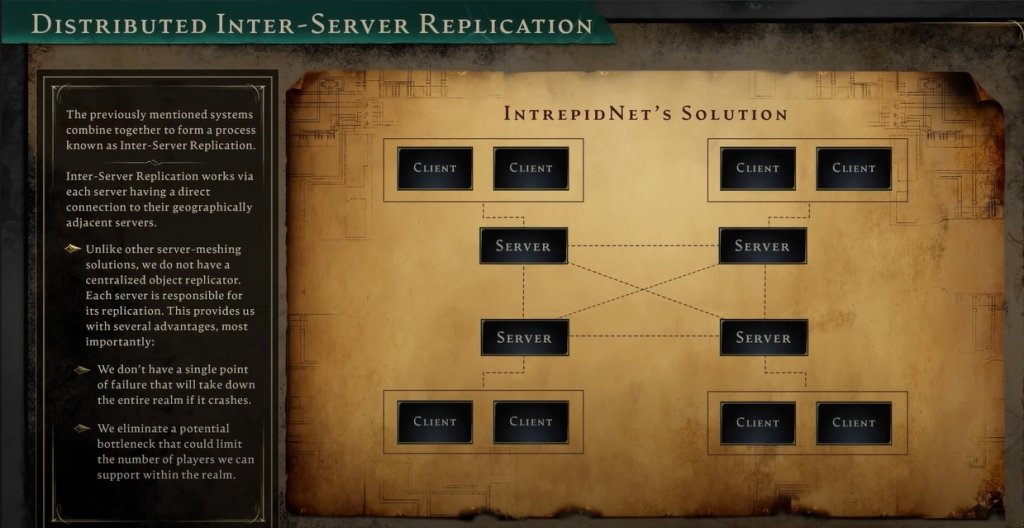
Ashes of Creation implementation of server meshing
The way these cells are managed varies according to the game’s ambitions. Some simply keep a static cells grid, others refine the size of the grid to be as precise as possible according to what’s going on, while some even plan for the cells to be moveable (to follow a spaceship, for example).
The quality vs. the quantity of the interactions
This future innovation raises questions about our ideas of massively multiplayer experiences. Is a MMO defined by its raw concurrent player count on an event, or by the quality of the interaction it allows? In my humble opinion, the best online worlds are those that allow for deep combat dynamics. As far as I’m concerned, Throne and Liberty pushed things too far on the spectrum of “quality vs. quantity of interactions” and, personally, this spoiled my experience. Nevertheless, I think it’s interesting that such a game exists, and I’m sure this approach will continue to appeal to a certain audience.
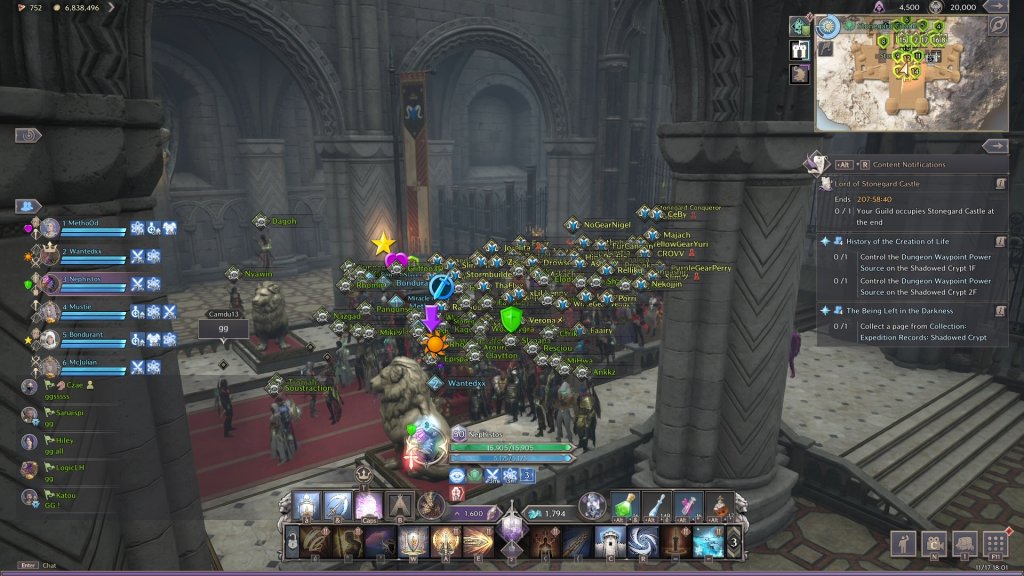
A siege of 3,900 players is impressive. To be honest, I see Throne and Liberty as an intriguing proof of concept. However, I would say that emerging technologies offer promising alternatives that, in my opinion, are better waiting for than current compromises.
If you ask me, future massive multiplayer games should not focus on how many players can fit into one battle (at least not at the cost of anything else, especially gameplay). Scale should enrich gameplay, not overshadow it. As developers keep pushing the edge, they must remember that any technical advancements mean little in the absence of compelling experiences.