
When Amazon first launched Luna in 2022, the pitch was simple: play anywhere, on anything, without the burden of a PC or console. It was the dream of frictionless gaming, powered by AWS infrastructure. Yet, for all its technical promise, Luna never really took off. The service struggled with a catalog of roughly a hundred titles, few of which could compete for attention against the catalog depth of Xbox Cloud Gaming or GeForce Now. Resolution was capped at 1080p, server performance drew criticism from early users, and device compatibility proved inconsistent across smart TVs.
Now, Amazon wants a do-over. “Later this year”, the company plans to launch what Jeff Gattis (Amazon Luna general manager) calls “the all-new Amazon Luna”, a reimagined version that aims to reintroduce the platform as something more socially alive. Amazon is re-framing Luna not around the solitary image of a gamer hunched over a controller, but around the living-room experience.
GameNight
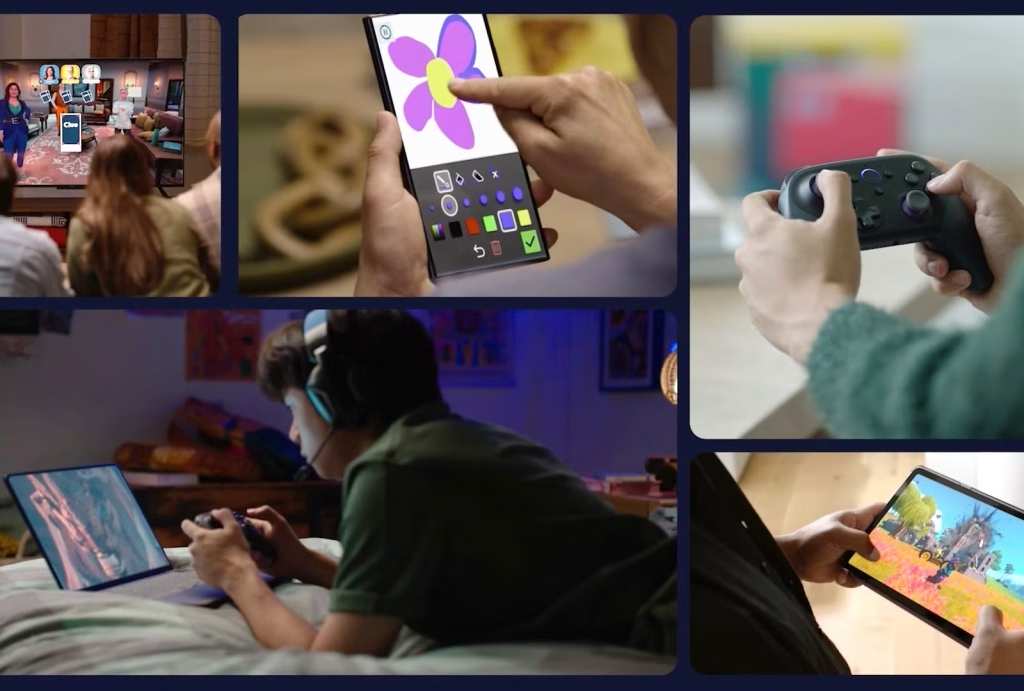
At the center of that new identity is GameNight, a feature that acts as both a content hub and a statement of intent. GameNight gathers a suite of social and family-friendly titles that can be played directly on a smart TV or tablet without the need for a controller. Players simply scan a QR code and use their phones as input devices. It’s an idea reminiscent of Jackbox Party Pack, designed to make gaming as spontaneous “as it is to watch Prime Video and stream music on Prime Music”. At launch, GameNight will include twenty-five titles or more, including Angry Birds, Exploding Kittens, and adaptations of board-game staples like Taboo, Ticket to Ride and Clue.
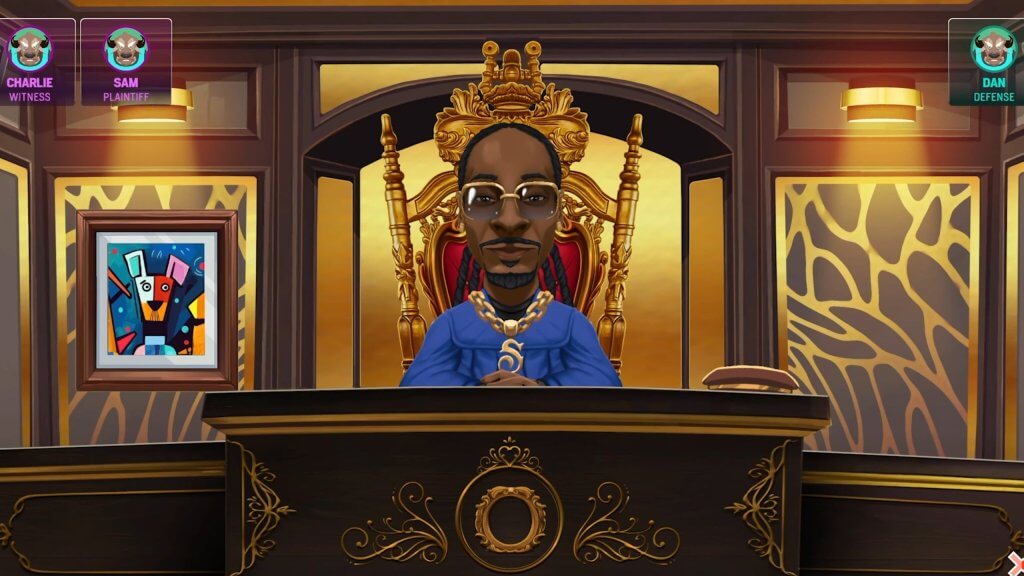
One of the flagship of this new collection is Courtroom Chaos: Starring Snoop Dogg, an AI-powered improv game where players argue absurd cases before a virtual version of the rapper. Using prompt-based AI, the game can generate “evidence” during the trial, with Snoop Dogg responding dynamically. I admit I’m quite puzzled by this proposal, but who knows? If the AI integration is smooth and relevant, it could be funny. At least, I can imagine it as a crazy game. Will it be remembered as an innovation – the first game that integrates GenAI as a game mechanic – or as a failed prototype? Only time will tell. Even though I’m a bit skeptical for now, I find it intriguing.
“You basically state your case. You can actually submit evidence through prompt-based AI, and it’ll generate the evidence in front of Snoop so we can look at the visual of the garbage bag or whatever the case is about,”
Jeff Gattis
Prime and Luna+
For those who crave more traditional fare, Luna 2.0 will also include “a diverse and growing library of more than 50 popular, classic, indie, and blockbuster games” accessible with Prime at no extra cost. This rotating selection leans on recognizable franchises and mainstream hits such as Hogwarts Legacy, Indiana Jones and the Great Circle, or Kingdom Come: Deliverance II. These games will still require a controller, but any Bluetooth device will work, and Amazon take this chance to try to sell its Luna Controller.
A higher-tier subscription, Luna Premium, will expand the catalog further, up to around a hundred titles including EA SPORTS FC 25, LEGO DC Super-Villains, or Batman: Arkham Knight, for $9.99 per month. It’s a structure built around low-barrier entry. The Prime-included base is there to entice, while Luna Premium provides the deeper experience for those who have been convinced. Even though I’m not particularly drawn to cloud gaming, let alone to Luna, the fact that it’s an additional service included with Prime does spark some interest. Since it doesn’t add any extra cost (assuming you are already a Prime subscriber), I could see myself testing this new Luna when it launches. However, seeing what the competition is up to, I don’t find it compelling enough to justify subscribing solely for Luna.
Who is Luna for?
Underneath the marketing optimism lies a more complex question: what kind of audience is Amazon actually trying to serve? In the traditional gaming landscape, ownership remains an emotional anchor. The ability to return to a game years later is part of its value. Luna, by contrast, offers an ecosystem of transience. Games come and go as licensing changes. A player in the middle of a long campaign could log in one morning to find their title rotated out. That ephemerality aligns with the rhythms of streaming culture – binges, rotations, seasonal content – but it sits uneasily with core-gamers.
“We’re continuing down the path with the console-friendly AAA games, which is why you see in the offering, we’re not just launching ‘GameNight,’ but actually expanding the library of AAA games that are available, as well as then games that work for really the non-core gamer, where you can pick up your phone as a controller and have a lot of fun with your family and friends in your living room,”
Steve Boom
Despite Steve Boom’s (Amazon’s VP of audio, Twitch and games) optimism and hopes of casting a wide net, Luna’s offer likely feel shallow to anyone with a Shadow PC subscription, an active Game Pass account, or a physical game collection. Odds are that the company isn’t actually chasing the same audience as Microsoft or Nvidia. But rather the hundreds of millions who play casually on mobile devices and treat games as a social activity rather than a hobby.
This argument is reinforced by Boom’s subsequent announcement that Amazon Games Studio has created another internal studio called Studio 5, dedicated to developing other “games for the non-core gamer” like “Courtroom Chaos”, “[That] tend to be smaller, social party games versus big, elaborate open-world AAA.”
What to expect from Luna?
In the end, Steve Boom seems intent on not alienating anyone. His language tries to hold the middle ground between the traditional gamer – those used to their consoles and PCs – and the wider, more casual audience Amazon wants to reach. Yet the company’s choices speak louder than its diplomacy. A whole new section devoted to family and social play, an internal studio built to produce party games, and the integration of Luna directly into Prime. All of it points in a very specific direction.
Luna is an attempt to weave gaming into the everyday rhythms of the household. It fits naturally into Prime, a service that already functions as a shared domestic ecosystem, from Prime Video to grocery deliveries. GameNight simply extends that logic: entertainment that doesn’t ask for expertise or investment, just participation. From that angle, the positioning is clever. It avoids fighting for territory that Xbox Cloud Gaming, GeForce Now, and PlayStation Plus already dominate, and instead reaches for the enormous space between: families, casual players, those who might never buy a console but who already live inside Amazon’s digital architecture.
For those of us steeped in more traditional genres – MMOs, long-form RPGs – it’s hard to feel directly addressed. I think that Luna’s design isn’t meant for us. That doesn’t make it irrelevant; it just situates it elsewhere in the landscape. As a Prime subscriber myself, I can see the appeal of testing it once it launches, if only out of curiosity. But I struggle to imagine paying an extra $9.99 for Luna Premium when so many richer ecosystems already exist.