
The Quinfall is one of those titles that struggled to be taken seriously from day one. This sandbox MMORPG, developed by Turkish studio Vawraek Technology, spent just over a year in Steam Early Access – from January 5, 2025 – before officially launching its version 1.0 on February 6, 2026. From its very first announcement in 2023, the title accumulated controversies and dubious claims, most notably its promise of a “world’s largest MMORPG map with an area of 2,016 km².”
A Studio Under Scrutiny
Even before reaching players, The Quinfall had already attracted attention – and not for the right reasons. The promise of a 2,016 km² open world is, on paper, genuinely impressive and likely exceeds the map size of most, if not all, MMORPGs. In practice, however, that vast space translates into emptiness: sparse NPCs, few enemies, and a thin quest density across large portions of the world. Add to that an overwhelming reliance on commercial asset store purchases, a practice debunked publicly by YouTuber Nuion as early as the 2023 announcement.
To be fair, using third-party assets is not inherently condemnable if done reasonably, without diluting a title’s identity. The Quinfall is nowhere near that standard. Its world is not only visually generic but also repetitive, with identical assets reused across multiple towns and locations. The overall impression is one of assembly rather than creation.
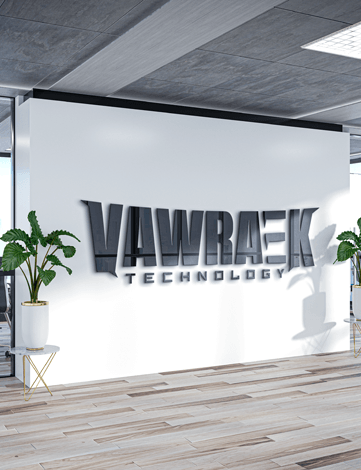
These concerns prompted the community to scrutinize Vawraek Technology more closely, and what they found was not reassuring. On LinkedIn, the company claimed at the time to employ between 50 and 200 people, a figure entirely inconsistent with the state of the product. Adding to the skepticism, the studio’s banner was identified as a stock photo simply overlaid with the Vawraek Technology logo. For a studio reportedly employing that much people, the inability to produce an authentic company photo is, at minimum, eyebrow-raising.
A Concerning Track Record
Vawraek Technology’s founding project, Kayra Online, provided important context. It remained in open beta for several months before being abandoned entirely. During that beta period, Kayra Online drew criticism not only for featuring pay-to-win items in its cash shop, but also for its affiliation with bynogame.com, a RMT marketplace whose logo appeared directly inside the in-game store. What followed in The Quinfall would suggest this may have been a partial preview of things to come.
Pay-to-Win and Community Censorship
The Quinfall’s enchantment system, heavily inspired by Black Desert Online, allows gear to be damaged or destroyed on a failed upgrade. Its monetization system, meanwhile, revolves around a premium currency called V Coins. Unsurprisingly, among the shop’s offerings is a token that shields equipment from destruction on a failed attempt, available for purchase once per week.
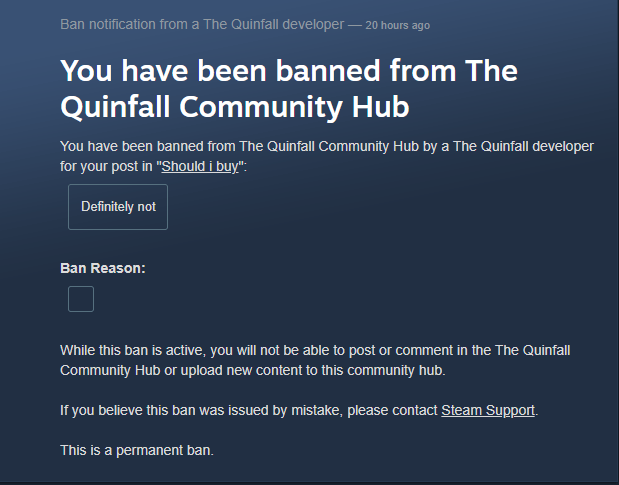
Selling a direct solution to that pain point for real money, even in time-gated quantity, is obviously a textbook pay-to-win mechanic. Still, players who raised these monetization issues in Steam reviews or on The Quinfall Community Hub were subsequently banned by the developers.
A Suspiciously Timed 1.0 Launch
The Early Access launch on January 5, 2025 – priced at $20, a steep ask given the aforementioned concerns – was rocky from the start. Servers were largely inaccessible to most players in the first days. Those who did manage to connect quickly reported progression shortcuts in the shop, alongside AI-generated dialogues. Within weeks of that Early Access, the game was being sold at discounts of up to 90%, often dropping below $1. This pricing pattern persisted for the vast majority of its Early Access life.
Then, in late January, Ashes of Creation announced the closure of its studio, sadly leaving its entire team unemployed. Within the following day of that announcement, Vawraek Technology raised The Quinfall’s price from $1 to $10, and announced an unexpected 1.0 release for February 6, 2026. The timing is difficult to interpret as coincidental. A community of MMORPG players suddenly without a game to look forward to, and The Quinfall positioning itself as a ready alternative.
Penalizing Early Supporters
If the opportunistic 1.0 timing was not damning enough, Vawraek Technology compounded the situation with a deeply inequitable refund policy for V Coins purchased during Early Access. The original plan was structured as follows: players who had bought V Coins in the last three months before the 1.0 launch would receive a 100% refund; those who purchased between three and six months prior would receive only 60%; those between six and nine months prior, just 20%; and anyone who had spent money before that nine-month window would receive nothing.
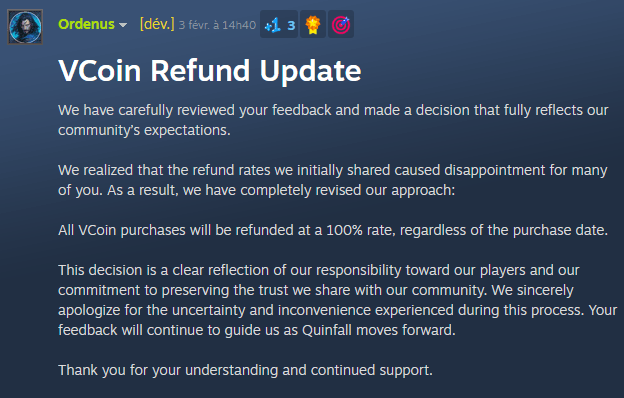
The earlier a player supported the project, the less they were compensated. Meanwhile, all progression was wiped because of the 1.0 release, leaving those earliest adopters with neither their in-game progress nor their money. The community’s reaction was swift and overwhelmingly negative. Faced with the backlash, the studio reversed course and announced that all V Coins purchases regardless of when they were made would be refunded at 100%. A minimum of decency, but one that required public pressure to materialize.
Stitched Together
Beyond the business and other already outlined concerns, The Quinfall also raises serious questions of creative originality. Its UI bears a striking resemblance to Black Desert Online’s one, as does its gameplay loop and several core systems.
Layer on top of that the significant reliance on store-bought assets, AI-generated elements, but also systems borrowed again from other games, such as a townboard reminiscent of New World or Ashes of Creation; and The Quinfall reads like an assembled puzzle of pieces found, purchased, and copied from various sources, arranged into what the developers believed a good MMORPG.
The Quinfall’s trajectory – from a controversial 2023 announcement, through a turbulent Early Access in January 2025, to an opportunistically timed 1.0 launch in February 2026 – paints a consistent picture. The red flags are numerous and corroborating: an abandoned predecessor with RMT ties, a world built on generic purchased assets, pay-to-win monetization, suppression of critical community feedback, and a business strategy that appears calibrated to exploit competitor misfortune. The evidence accumulated to date does not inspire confidence.